
Most people who come to therapy carrying stress or anxiety also mention something else: a tight neck, a back that aches by mid-afternoon, shoulders that sit somewhere around their ears by the end of the working day. They tend to think of these as separate problems. The physical discomfort is for a physiotherapist; the worry and the mental noise are for a therapist.
In practice, the two are rarely separate at all.
The way you hold your body in moments of stress is not incidental. It is part of the stress response itself. And over time, those physical patterns can become so habitual that they stop feeling like reactions to anything. They just feel like you. Understanding that connection is one of the most useful things you can do if chronic tension, anxiety, or both have become part of your daily experience.
Your Body Responds to Stress Before You Notice It
When a stressful thought arrives, whether it is a deadline, a difficult conversation, or a creeping sense that everything is slightly too much, your body is already responding. Your neck tightens. Your breathing becomes shallower. Your shoulders edge upwards. Your jaw may clench. These are automatic, involuntary reactions that happen in a fraction of a second, long before you have consciously registered that something feels threatening.
This is the fight-or-flight response at work. The body prepares itself to deal with a perceived threat. The problem is that in modern life, the threats are rarely physical. They are relational, professional, or existential. But the body does not know the difference between a predator and an overflowing inbox. It responds the same way each time.
If that stress is sustained, as it often is for people navigating demanding jobs, difficult relationships, or ongoing anxiety, the body never quite gets the signal to stand down. The muscle tension never fully releases. The shallow breathing becomes the default. The shoulders stay raised. Over weeks, months, and years, these become the body’s resting state.
How Habitual Tension Becomes Invisible
One of the things Frederick Matthias Alexander observed in himself, and later in thousands of people he worked with, is that we stop noticing our own patterns of tension. They become so familiar that they stop registering as tension at all. They just feel normal.
You may not notice that you are holding your breath while reading your emails. You may not feel the tightening in your neck as you check your phone. The habit has become so ingrained that the body’s own feedback system has stopped flagging it. Alexander called this ‘debauched kinaesthesia’: the sensory system becomes unreliable precisely because the pattern has been running for so long.
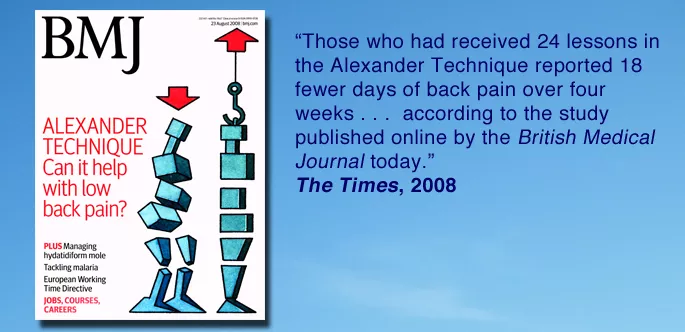
This matters for two reasons. First, the physical toll accumulates. Chronic compression in the neck and back, shallow breathing, excessive muscle tension: these are not trivial. Research published in the BMJ has shown that the Alexander Technique produces significant long-term reductions in back pain, and evidence points to similar effects for neck pain. But the physical discomfort is often only part of the picture.
The second reason is less obvious but equally important. Habitual bodily tension does not just accompany anxiety. It can actively sustain it. When the body is in a state of low-level contraction, it sends signals back to the nervous system that maintain the stress response. Shallow breathing, a tight chest, raised shoulders: these are the physical hallmarks of anxiety. If the body remains in that state, the psychological experience of anxiety has somewhere to live. If you are also experiencing negative thinking about future events, that physical backdrop makes it harder to step back from those thoughts.
The Alexander Technique: What It Actually Does
The Alexander Technique is often described as a method of postural re-education, which is accurate but slightly misleading if it suggests something corrective or exercise-based. It is not about forcing the body into a ‘correct’ position or developing strength. It is about learning to notice, and then interrupt, the habitual patterns of tension and misuse that have built up over a lifetime.
The central idea is what Alexander called ‘inhibition’: the capacity to pause before reacting automatically, and to make a different choice. In practical terms, this means developing enough awareness to catch the moment your neck tightens before you look at your screen, or to notice the held breath before you begin a difficult conversation, and to allow both to soften before proceeding.
In a session, a trained teacher uses gentle, hands-on guidance alongside verbal instruction to help you experience a different quality of movement. The touch is light and non-invasive. The work typically involves simple activities: sitting down and standing up, walking, lying in ‘semi-supine’ position with knees bent. The aim is not to teach you new exercises but to help you recognise the unnecessary effort you are bringing to ordinary activities, and to experience what it feels like to move without it. If you are curious about the foundational principles, my plain-English guide to the Alexander Technique is a useful starting point.
What research shows
The evidence base for the Alexander Technique is strongest in two areas: chronic back pain and chronic neck pain. A landmark trial published in the BMJ in 2008 found that 24 Alexander Technique lessons produced the greatest long-term reduction in back pain of any intervention tested, with benefits maintained at 12 months. A subsequent trial published in the Annals of Internal Medicine found significant reductions in neck pain over the same period.
Evidence for anxiety and stress is more limited, but the theoretical rationale is well-supported. The Technique works directly on the nervous system’s habitual responses. When those responses involve the physical patterns of stress and anxiety, which they almost always do, addressing them at the level of the body creates a different input for the nervous system to work with.
The Connection to Stress and Anxiety: Why the Physical Matters
If you have experienced anxiety for any length of time, you will know that it is not only a mental experience. The chest tightens. Breathing becomes restricted. The jaw clenches. The gut churns. These are not side effects of the anxiety: they are part of it. The mind and body are not separate systems running in parallel. They are one system, influencing each other continuously.
This is why working only at the level of thought, useful as that is, sometimes has limits. Cognitive approaches like CBT are highly effective at helping people examine and shift the thought patterns that maintain anxiety. But if the body remains in a habitual state of contraction that mirrors the anxiety response, there is an ongoing physical signal reinforcing the psychological experience.
The Alexander Technique offers a way to work on the other side of that loop: to create change in the nervous system by changing what the body is doing. When the breath is fuller, the neck less tense, and the posture less compressed, the sensory information reaching the brain is different. The body is no longer broadcasting alarm. That physical shift can make psychological space for a different relationship with anxious thought.
What This Looks Like in Practice
Consider what happens for many people who work at a desk. As concentration deepens, the head drifts forward. The neck tightens to hold it there. The shoulders round. The breathing becomes shallow. The ribs compress slightly inward. None of this is conscious. It is simply the habitual response to sustained mental effort. By the end of a working day, the back aches, the neck is stiff, and there is a background hum of tension that can be difficult to explain or name. For many people, that same unresolved tension also disrupts sleep.
Now consider that this same pattern, in a more acute form, is what the body does when anxious. The compression, the held breath, the tightened neck: these are the physical signature of the stress response. For someone who spends eight hours a day in a mild version of that state, the body is, in a very real sense, practising anxiety. It is rehearsing the physical conditions under which anxiety persists.
Learning to interrupt that pattern, to notice the moment before it deepens and to choose a different response, does not just reduce the physical discomfort. It begins to change the body’s default state. Over time, that has consequences for how stress and anxiety are experienced throughout the day.
How This Fits Within a Therapy Approach
My work combines CBT with somatic approaches, including the Alexander Technique, because I have found that addressing both the cognitive and the physical dimensions of stress and anxiety tends to produce more sustainable change than working with either alone.
CBT provides a structured framework for examining the thought patterns, beliefs, and behaviours that maintain anxiety. It is evidence-based, practical, and effective. If you are also dealing with workplace stress and burnout, CBT has well-established tools for that specifically. What the somatic dimension adds is attention to how those patterns live in the body. Patterns of tension, postural habits, and the physical responses to stress are not incidental to anxiety. They are part of how it perpetuates itself.
In therapy, this might mean exploring the thoughts that drive a stress response alongside the physical habits that sustain it. It might mean developing the body awareness to notice the early, subtle signals of anxiety building, before it reaches the point where it feels overwhelming. It might mean finding, through experience rather than instruction, what it feels like to be less tense, and discovering that the feared outcome does not follow.
This integrated approach is not about fixing a body that is wrong. It is about developing a more conscious relationship with the way you use yourself, so that habitual patterns can be recognised and, gradually, changed. You can read more about what this looks like in practice on the somatic therapy page, or find out what to expect from therapy more generally.
Frequently Asked Questions
Is the Alexander Technique the same as physiotherapy?
No. Physiotherapy typically addresses specific injuries or conditions through exercises and manual treatment. The Alexander Technique is educational: it works by developing awareness of habitual movement and postural patterns so that you can choose to respond differently. The two can complement each other, but they are distinct approaches.
I have back or neck pain. Is this relevant to me?
Very likely, yes. Chronic back and neck pain is one of the areas where the Alexander Technique has the strongest evidence base. But the approach in my practice goes beyond addressing physical discomfort in isolation: it also explores the relationship between those physical patterns and the stress or anxiety that often accompanies them. If both are present, working on the connection between them tends to be more useful than treating each separately.
Do I need to have any body awareness to start?
Not at all. In fact, most people begin with very little conscious awareness of what their bodies are doing, which is precisely why habitual patterns take hold in the first place. Developing that awareness is part of the work, not a prerequisite for it.
How is this different from mindfulness or yoga?
There are meaningful overlaps: all three involve attention to the present moment and to the body. The Alexander Technique is distinct in its focus on the head-neck-back relationship as primary, its emphasis on inhibiting habitual reactions rather than relaxing or stretching, and its educational basis: you are learning to understand and change your own patterns, not following a set of exercises or practices.
How many sessions would I need?
This varies considerably. Some people notice a significant shift in physical and psychological experience within six to ten sessions. The 2008 BMJ trial found that 24 lessons produced the most durable improvement in chronic back pain, but meaningful change can begin well before that. In the context of therapy, the Alexander Technique is integrated into sessions rather than being a standalone treatment, so the question of session number is part of a broader therapeutic conversation. You can read more about what to expect in therapy before getting in touch.
Can the Alexander Technique help with anxiety specifically?
It can form a useful part of working with anxiety, particularly where the physical dimension of anxiety is pronounced. It does not replace psychological therapy, and it is not a treatment for anxiety disorders in the clinical sense. What it offers is a way of working with the body’s role in sustaining anxiety, which for many people opens up possibilities that purely cognitive work does not reach.
Working With Me
If chronic tension, stress, or anxiety are affecting your quality of life, and you are curious about how working on both the cognitive and somatic dimensions might help, I offer an initial consultation where we can explore whether this approach would be a good fit for you.
Sessions take place in North West London and online.