
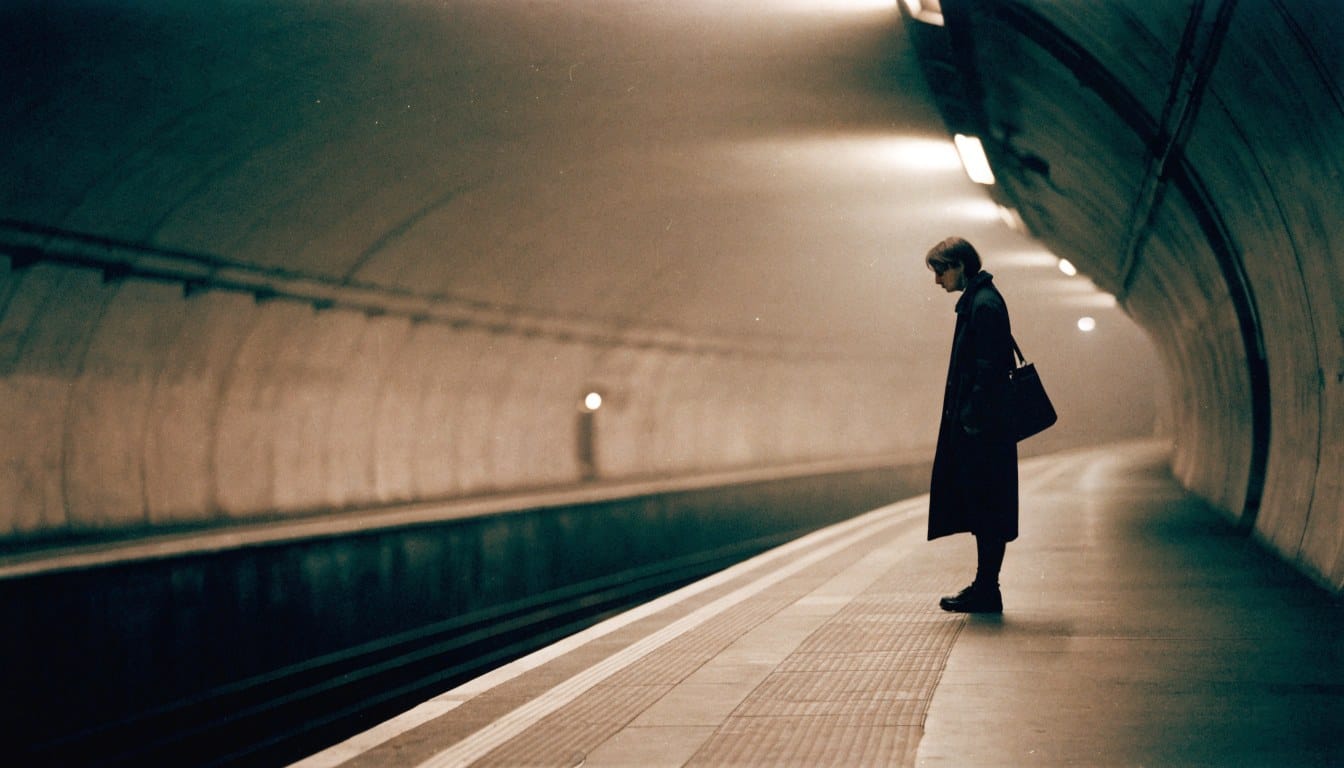
Burnout rarely announces itself at work. It shows up in a tight jaw in a meeting, an email you read four times, a commute home that no longer brings you down.
Most people who are burning out at work are still turning up. They are still answering emails, still sitting in meetings, still hitting most of their deadlines. From the outside, very little looks wrong. The signs of burnout at work are usually quieter than that, and they tend to show up first in places people do not think to look: the body at the desk, the way a colleague's message lands, the evening that never quite feels like an evening.
It is not a niche experience. In Mental Health UK's Burnout Report 2026, based on YouGov polling of more than 2,500 UK workers, 91% said they had experienced high or extreme levels of pressure or stress at work in the past year, and one in five had taken time off because of poor mental health caused by stress. Many more are still at their desks, working through it.
This post is about how burnout shows up specifically at work: in meetings, at the desk, on the commute, in your relationships with colleagues and in your performance. It pays particular attention to the physical signals, because in my experience they are usually the first to appear and the last to be taken seriously.
Why the signs of burnout are so easy to explain away at work
Work is very good at supplying explanations. It is a busy quarter. There is a restructure. A colleague has left and you are covering. The project will land in six weeks and things will settle after that. Each explanation is plausible on its own, which is exactly what makes them effective at hiding a longer pattern.
The workplace also rewards the very behaviours that burnout produces in its early stages. Staying late reads as commitment. Answering messages at eleven at night reads as reliability. Going quiet in meetings can pass for focus. By the time the signs become visible to anyone else, they have often been present for months.
If you want the broader picture of how burnout works across life as a whole, my post on burnout symptoms covers what burnout is, how it is defined and why it develops. Here the focus is narrower. It is about what burnout looks and feels like between nine and six, and in the hours either side that work has quietly claimed.
Physical signs of burnout at work: where the body speaks first
The body tends to register sustained pressure before the thinking mind is willing to name it. At work, that registering happens in small, repeated moments that are easy to dismiss one at a time. Taken together, they form a pattern worth paying attention to.
In meetings
Notice what your body does when a particular meeting appears in your calendar, or when a certain person starts speaking. Many people find they are holding their breath slightly, or breathing only into the top of the chest. The jaw sets. The shoulders rise a few millimetres and stay there. Some people describe a kind of fixed, attentive face they put on, and the effort of holding it for an hour.
After the meeting, there is often very little relief. The body stays braced because the next thing is already arriving. This is one of the clearer physical signs of burnout at work: not the tension itself, which everyone feels at times, but the absence of any release afterwards.
At the desk
The desk is where the long, slow version of burnout tends to live. You may notice that you have been leaning towards the screen for an hour without moving. Your neck aches by mid-morning. Your eyes feel dry and heavy. You realise at three o'clock that you have not had a drink of water or stood up since lunch, or that lunch did not really happen.
Many people also notice a characteristic slump arriving earlier in the day than it used to. Not ordinary afternoon tiredness, but a sense of the body folding in on itself, the chest closing, the head drifting forward, as though holding yourself upright has become one more task on the list.
On the commute
The commute used to be a threshold. For many people it was where work gradually loosened its grip, a stretch of the Jubilee line or a walk from the station that marked the shift from one part of the day to another. In burnout, that transition often stops working.
You may find you are still composing replies in your head as you walk home. You arrive at your front door with your shoulders still up by your ears. Some people describe sitting in the car outside the house for ten minutes, not because they want to be alone, but because they cannot yet face the effort of being with anyone. The body is home. It has not come off shift.
In the evenings and at the weekend
One of the more telling signs is a particular combination: exhausted but unable to rest. You are too tired to do anything that would restore you, but too wired to sleep well. You lie down and your mind begins running through tomorrow's meetings. You wake at four with an email already half-written.
Weekends can take on a similar shape. Saturday is spent recovering enough to function. Sunday afternoon, the body starts preparing for Monday before you have consciously thought about it. The space in which rest was supposed to happen has shrunk to a few hours on a Saturday evening.

What burnout does to your thinking at work
The cognitive signs of burnout at work are often mistaken for a competence problem, which is part of why they are so distressing for people who have always been capable.
You might notice you are reading the same email three or four times without taking it in. A decision that would once have taken a minute sits in your inbox for a week, not because it is difficult, but because you cannot quite gather yourself to make it. You come out of a meeting and struggle to remember what was agreed. You open a document, look at it, and open another one.
There is often a narrowing too. The part of your work that involved judgement, creativity or seeing a problem from an unexpected angle becomes harder to reach. You find yourself choosing the safe, familiar task over the one that actually needs doing, because the familiar task asks less of you. The work still gets done. It simply costs far more than it should.
These are not signs that you have become worse at your job. They are signs that a system running under sustained load has started to protect its remaining resources. Thinking is metabolically expensive. When the body has been in a prolonged state of readiness, complex thinking is one of the first things it economises on.
How burnout changes the way you are with colleagues
Colleagues are often the first people to see burnout, even if they would not use that word. What they notice is a change in how you are with them.
Irritability is common. A short message from a colleague lands as a criticism. Someone asking a reasonable question in a meeting feels like an imposition. You draft replies that are sharper than you intend and then either send them and regret it, or spend twenty minutes softening them.
Withdrawal is common too. You stop going for lunch with people. You leave your camera off on calls when you used to keep it on. You avoid the kitchen at the times you know it will be busy. Social contact at work, which once gave you something back, now feels like another thing you have to perform.
There is also a quieter shift that people often find hard to admit. If you have been the reliable one for a long time, the person others come to, you may notice a growing resentment towards the very people you used to be glad to help. A creeping cynicism about the organisation, the team or the point of it all can follow. This tends to feel out of character, and it often carries a layer of guilt on top of the exhaustion.
The performance paradox: why output is often the last thing to go
People who are burning out often point to their performance as evidence that they are fine. The reviews are still good. The projects are still delivered. And that is frequently true, for longer than you might expect.
What changes is not the output but the cost of producing it. The same report takes you an evening and a Sunday morning rather than an afternoon. You compensate for slower thinking with longer hours. You rely on adrenaline to get through presentations that used to feel straightforward. From the outside, the line on the graph looks flat. From the inside, the effort required to keep it flat keeps climbing.
When performance does eventually slip, it tends to happen in small ways first: a missed detail, a forgotten follow-up, a deadline that moves for the first time in years. For high-achieving people, these early lapses can be deeply unsettling, and the usual response is to push harder. That response is understandable. It is also, very often, what accelerates the burnout.
From running hot to running flat: how the signs change over time
One of the most useful things to understand about the signs of burnout at work is that they tend to change as it deepens. The early phase and the later phase can look almost opposite, which is why people sometimes miss the transition.
In the earlier phase, the nervous system is over-activated. You are running hot: working late, unable to switch off, tense, quick to react. In the later phase, that activation cannot be sustained, and something closer to a shutdown sets in. You are running flat: going through the motions, numb, disengaged, heavy. The table below sets out how each phase commonly shows up at work.
| At work | Running hot (earlier) | Running flat (later) |
|---|---|---|
| In meetings | Braced, jaw tight, breath held, quick to interrupt or defend | Present in body but not in mind, camera off, little to contribute |
| At the desk | Leaning in, hours without moving, cannot stop checking | Slumped, heavy, staring at the screen, tasks left half-started |
| Thinking | Racing, over-preparing, rehearsing conversations | Foggy, slow, decisions deferred, memory gaps |
| With colleagues | Irritable, impatient, sharp replies | Withdrawn, cynical, indifferent to things you once cared about |
| Evenings | Wired, answering emails late, poor sleep | Collapsed on the sofa, too tired to do anything restorative |
| Performance | Maintained through extra hours and adrenaline | Small errors appear, deadlines slip, effort no longer produces results |
Most people do not move cleanly from one column to the other. It is common to swing between them within a single week, wired on Monday and flat by Thursday. What matters is recognising both as part of the same process, rather than treating the flatness as laziness or the tension as simply how work is.
Why the body matters in recognising burnout
Most advice about burnout at work is cognitive. Reframe your thinking. Prioritise. Set boundaries. Those things have value, and I use cognitive work a great deal in my own practice. But on their own they tend to miss something important.
Many of the people I see have already tried to think their way out of burnout. They understand it very clearly. They can describe their patterns in detail. And yet the body is still braced every time they open their laptop, still slumped by mid-afternoon, still unable to settle in the evening. Understanding the problem has not changed what the body is doing.
This is where working with the body directly becomes useful. My approach combines CBT with the Alexander Technique, a body-based method that develops awareness of how you habitually organise yourself under pressure. It is not relaxation training. It is a way of noticing what your body is doing in the moment, the held breath, the raised shoulders, the collapse through the chest, and learning that you have more choice about it than you thought. If you are curious about the method itself, this plain-English guide to the Alexander Technique explains how it works.
The physical habits that burnout produces are not random. As I explore in how postural habits connect to stress and anxiety, patterns of tension can keep the nervous system in a state of readiness long after the pressure that created them has passed. Working with those patterns tends to make the cognitive work land more fully, because thoughts are easier to examine when the body is not already on alert.
To give a sense of what this can look like, consider a fictionalised example. Maya, a senior associate at a firm in the City, came to therapy saying she was "just tired". She was still performing well. In our early sessions, it became clear that she was holding her breath almost every time she read an email from one particular partner, and that her shoulders stayed raised for most of the working day. None of this was something she had noticed. Once she began to register it, those moments became points where she could pause, let the breath move and notice what she was actually telling herself about the email. Over time, the physical bracing eased, and so did the story that every message was a verdict on her competence.
A simple check-in during the working day
You do not need to be in therapy to begin noticing these signals. A useful starting point is to choose three moments in the working day and simply observe what your body is doing, without trying to fix it.
- Before you open your inbox in the morning: where is your breath, and what are your shoulders doing?
- Straight after your most demanding meeting: is there any release, or does the tension carry straight on into the next task?
- As you leave work or close the laptop: does anything in the body let go, or does it stay on shift?
The aim is not to relax on command. It is to gather information. After a week or two, most people find a pattern emerges, and that pattern is often a more honest account of how things are than anything the mind has been saying.
When the signs mean it is time to get support
Some signs of burnout at work respond well to practical change: a conversation with your manager about workload, protecting time without meetings, taking leave that you actually use for rest. It is worth trying those things, and trying them properly.
But if the signs have been present for several months, if they have returned after previous breaks, or if you notice the flatness described above settling in, it is usually a signal that something more than a lighter week is needed. A GP can check whether anything physical is contributing and talk through whether time off would help. Many employers also offer occupational health support or an employee assistance programme.
Therapy is most useful when the pattern keeps repeating, or when you can see clearly what is happening but cannot seem to change it. That is often a sign that the drivers are less about the job itself and more about how you relate to work. If you would like to understand how the cognitive side of this works in practice, my post on CBT for workplace stress and burnout goes into more detail. If what you are experiencing feels more like persistent dread than depletion, work anxiety may be the more accurate description, and the two call for somewhat different things.
I work with people in person at my practice in North West London, near St John's Wood and Maida Vale, and online across the UK. You can read more about how the body-based side of the work fits in on my somatic therapy page.
Frequently Asked Questions
What are the first signs of burnout at work?
The earliest signs are often physical and easy to dismiss: tension that does not release after meetings, broken or unrefreshing sleep, a commute home that no longer helps you switch off, and needing longer to do work that used to feel straightforward. Many people also notice a slight shortening of patience with colleagues before they notice anything else. The first signs tend to look like being busy, which is why they are so often missed.
Can burnout cause physical symptoms?
Yes, and they are often the most reliable signal. Common physical signs of burnout include persistent fatigue, headaches, muscle tension in the neck, shoulders and jaw, digestive problems, disrupted sleep and picking up more colds than usual. At work, you may also notice shallow breathing, a habit of holding your breath and a posture that collapses earlier in the day. These are not separate complaints. They are the body responding to sustained pressure.
Can you be burnt out and still performing well at work?
Very often. Many people who are burning out maintain their output for months by working longer hours and relying on adrenaline. What changes first is the effort it takes, not the result. If your performance looks fine but it is costing you evenings, weekends and sleep to keep it there, that is worth taking seriously.
Is burnout a recognised medical condition in the UK?
The World Health Organization's ICD-11 classification describes burnout as an occupational phenomenon rather than a medical condition. It is defined by exhaustion, mental distance from your job and reduced effectiveness at work. That does not mean it is not taken seriously. GPs in the UK can and do issue fit notes for work-related stress, and the symptoms that come with burnout can be assessed and supported in the same way as other health concerns.
How do I tell my manager I am burnt out?
It often helps to be specific rather than general. Instead of saying you are struggling, describe what has changed: the hours you are working, the tasks that are taking longer, the effect on your sleep or concentration. Then say what would help, whether that is reprioritising, redistributing work or taking time off. If a direct conversation feels too difficult, HR or occupational health can be a starting point.
Should I leave my job if I am showing signs of burnout?
Sometimes a job genuinely is the problem, and leaving is the right decision. But burnout has a habit of following people into new roles when the underlying patterns, such as difficulty saying no, perfectionism or tying your worth to output, have not changed. It is usually wise to understand what has been driving the burnout before making a major decision, so that whatever you choose next is a choice rather than an escape.
The signs of burnout at work are rarely dramatic. They are small, repeated and easy to talk yourself out of. But the body tends to be honest in a way the mind is not, and learning to listen to it is often where a different way of working begins.
If you recognise yourself in this post and would like to explore whether therapy might help, I offer an initial consultation with no obligation. You can book a free consultation here, or read more about what to expect in therapy before getting in touch.